Real People, Real Stories, and How We Find Them
How we choose the people you play, from picking the moment to digging through the records, and two stories that come from our own families.
The Timekeeper · 2026-11-14
When we started building Live Through Time, the stories were archetypes: a US Marshal in the Old West, an English navigator in Edo, an escape helper in Berlin. They worked, but they were nobody in particular. Over the past year we’ve rebuilt almost the whole roster around people who really lived: Virgil Earp in Tombstone, William Adams in Edo, Hasso Herschel in Berlin.
This spotlight is about how we find them, what we keep, what we make up, and two stories that are closer to home than any of the others.
We start with a moment
Before we choose anyone, we choose a day. Every era so far opens at a single moment when something is about to break (next week’s WW2 eras change that): Tombstone six weeks before the gunfight, 1917 the day Passchendaele falls and the night before the Bolsheviks storm the Winter Palace, Berlin in the week NATO’s Able Archer exercise nearly started a nuclear war.
Then we ask one question: who was there that morning, and what were they doing? Not what they’re famous for, or what they did ten years later, but that day. Wyatt Earp in September 1881 isn’t the legend yet. He’s a gambler with ambitions, and he’s sneaking off to meet the sheriff’s girlfriend.
Then the fun begins
Making up a character from scratch is great, but it’s the research into real people that we enjoy most. We start with AI, which is a quick way in to names, dates and events, and then check everything against the sources. When we were putting together our First World War era, it was originally set in 1916. We wanted it to span several fronts rather than just the trenches, but it was hard to find a single date when something was happening everywhere at once. So we moved it to November 1917, when the whole world really was at breaking point.
Then we read as much as we can about the people who were there, learn their lives and choose the most interesting stories for the game: Jane Sissmore, who would become MI5’s first female officer, or Hans Rose, a U-boat commander known for his chivalry towards the crews of the ships he sank.
Sometimes the research changes the whole era, not just the year. Berlin never felt right until we stopped inventing an escape helper and used a real one. Hasso Herschel helped more than a thousand East Germans escape to the West and dug the famous Tunnel 57. Our story is named after it, as a tribute to Herschel, who died earlier this year at the age of 91.
The people around them are real too
A real person needs a real world around them. Where the records allow it, the people your character works for, argues with and depends on are real as well: the officers on the same ship, the marshal at the next table, the editor across the street.
The details matter just as much. What a pint cost, which paper was on the breakfast table, what the uniform was made of, which guns had and hadn’t reached the front. The game holds the narrator to all of it. That’s why there are no Tommy guns in 1917, and why a Bexleyheath greengrocer counts his pay in shillings and pence.
What we make up and what we won't
We can’t know what anyone was thinking, so their inner lives are where we let ourselves imagine. The secrets, the private wants and the grudges that drive the story are ours, written to fit everything we do know.
But these were real people, and we owe them care and respect. We will never give anyone a crime or a betrayal the record doesn’t support.
Two of our own
Two of the people in the game are family.
Edwin George Lloyd (1917: Mud & Revolution)
Edwin George Lloyd was my great-grandfather. While we were researching our 1917 era, we got the family papers down from the loft and went through his records, photographs more than a hundred years old and the online family history databases. We learnt more than we had ever known.
In 1917 he was a greengrocer from Bexleyheath in Kent, who had lost two baby sons before the war. From the local newspapers we learnt that when a military tribunal turned down his hardship appeal in September 1916, he went straight to the Royal Navy rather than wait to be sent to the trenches.
Because we were researching a real person rather than an archetype, we could try to find out exactly where he was on the day our story starts, and we were lucky enough to find the complete logbooks of his ship.
By November 1917 he was an Ordinary Seaman, working as a Blacksmith’s Mate on the old cruiser HMS Pyramus. The ship had just spent a month in the Red Sea, her 4-inch guns firing on Ottoman positions at Zi Hill, and was now in dry dock at Suez, being painted for a visit from Prince Faisal, the leader of the Arab Revolt. The officers in his story, Commander Crispin, Lieutenant Commander Young and the unfortunate Lieutenant Dunbar, who was reprimanded for smoking on watch, were the real officers of the Pyramus at the time.
When he came home the following year, his wife sadly died of influenza, which was rife at the time. He later married her sister, which was not unusual then, and my grandfather was born a year or so later.
His story is Iron, Heat and Empire, in 1917: Mud & Revolution and the background behind it is his real naval service record.
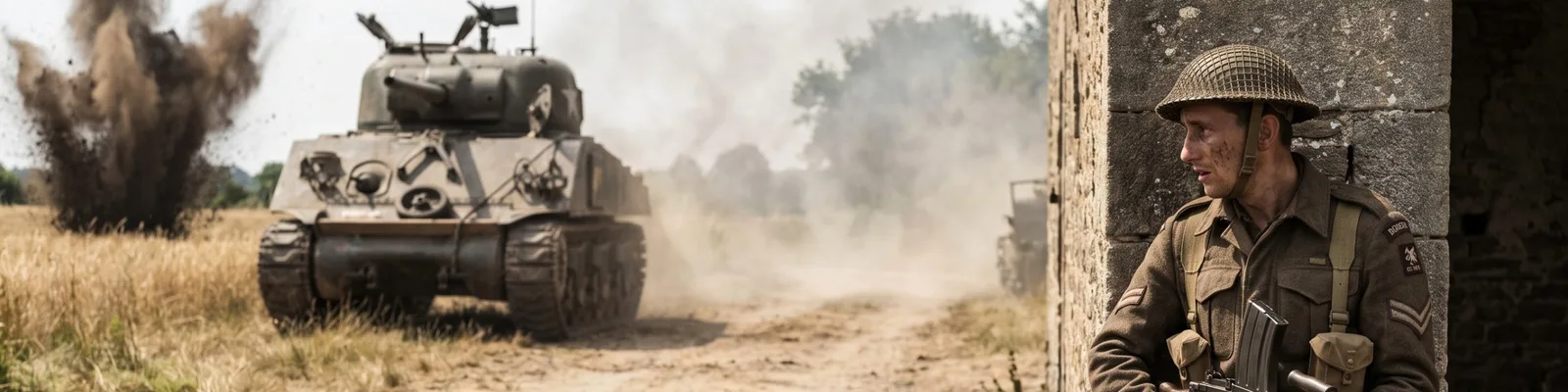
Leonard 'Triz' Shelley (WW2: Shrapnel & Steel)
Leonard Shelley, Triz to everyone who knew him, was my wife’s grandfather. He was one of ten children of a hay cutter and thatcher in Hockley, Essex, and had been delivering milk, newspapers and groceries since he was eleven. By the time he was called up to Warley Barracks in October 1939, he drove a lorry for a builders’ merchant.
He spent years as the driver for his battalion’s colonel, until the battalion was broken up and he found himself in the 4th Dorsets, carrying a Bren gun into Normandy. He fought outside Caen alongside the Canadians, ran a cornfield under tracer fire and marched thirteen German prisoners out of a farmhouse.
Like most men of his generation, he rarely talked about the war, so we’re lucky that he wrote it all down. He was wounded by mortar fire at a crossroads near Falaise, the day his story begins, and sent home to be patched up. Then he went back to his battalion, crossed the Rhine, fought on through Holland and Germany, and was there when his brigade relieved Bergen-Belsen.
His story, The Luck of the Draw, opens in August 1944, on the road to Falaise, and arrives with our new era, WW2: Shrapnel & Steel, later this month.
Perhaps by playing these real people, we can learn a little more about history, about them, and maybe about ourselves along the way.
Your family's story
Almost everyone has someone: a great-grandmother in a munitions factory, a grandfather on a convoy, an uncle at the Somme. Some of the best stories in history were never written down, and we'd love to hear yours.
Who in your family would you want to play? Tell us on Discord.
In the manual: Choosing an Era · Archetypes & Characters · Historical Realism (Mature Mode)
Thanks for reading.
See you in the past…
The Timekeeper